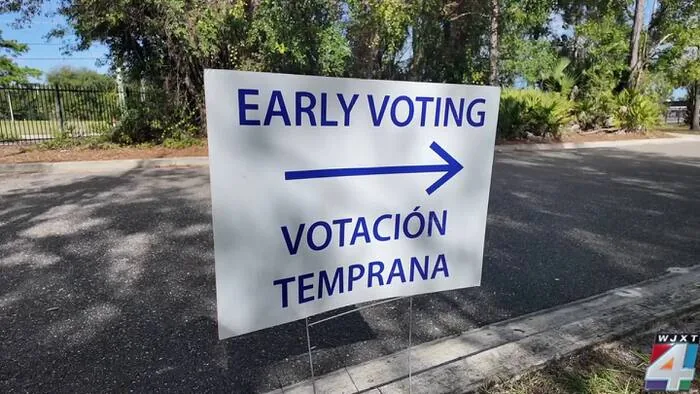
JACKSONVILLE, FL — Florida voters will weigh three statewide constitutional amendments on their 2026 ballots, and each proposal needs at least 60 percent approval to become part of the state constitution. The changes cover the state’s reserve fund, tax relief for some agricultural equipment and a major overhaul of homestead and property-tax rules.
Because the ballot language can be dense, the amendments are drawing attention not just for what they say, but for what a yes or no vote would actually do. Support and opposition also cut across party lines on at least one of the measures, making the debate more complicated than a simple partisan split.
Amendment 1 would greatly expand Florida’s rainy day fund
The first proposal would raise the cap on Florida’s Budget Stabilization Fund from 10 percent of the previous year’s general revenue collections to 25 percent. The reserve fund, created in 1992, is meant to help the state handle revenue shortfalls or emergencies.
Under the amendment, lawmakers would also be required to transfer the lesser of $750 million or whatever amount is needed each year to reach the new cap, unless certain conditions apply. The Legislature could suspend the transfer after a withdrawal for a shortfall or emergency, and with a two-thirds vote in each chamber it could pause a transfer for a critical state need, but no more than once every five years.
Once the fund reaches 15 percent of revenue collections, lawmakers could use some of it for a critical state need, as long as the balance does not drop below 10 percent. The amendment does not define what counts as a critical state need.
Support for the reserve proposal crosses party lines
Support for Amendment 1 is not neatly divided by party. The Republican Party of Florida backs it, but Gov. Ron DeSantis has called it “foolish.” At the same time, some local Democratic groups are recommending a no vote, while Democratic nominee for governor David Jolly says he supports the measure.
Jolly’s opponent, U.S. Rep. Byron Donalds, opposes it. Florida TaxWatch also described the amendment as a close call, saying it agrees the 10 percent cap should be higher but worries that mandatory annual deposits of $750 million could be too rigid over time.
Even so, Florida TaxWatch ultimately recommends a yes vote. In practical terms, a yes would create a much larger reserve and make deposits routine, while a no would keep the existing cap and preserve more legislative flexibility over how to use state revenue.
Amendment 2 would exempt some farm and agritourism equipment from property tax
The second amendment would create a property-tax exemption for certain tangible personal property used on agricultural land. That includes machinery, equipment and tools that are typically located on the land, used to produce agricultural products or support agritourism, and owned by the landowner or leaseholder.
The exemption would begin with the 2027 tax year. The constitutional change would not apply to land or buildings, but to qualifying personal property associated with farming and agritourism operations.
A yes vote would remove that qualifying property from ad valorem taxation, with the Legislature expected to fill in the details through future law. A no vote would leave the current system in place, including the existing general exemption for the first $25,000 of assessed tangible personal property available to businesses.
Farm groups see relief, while critics point to existing exemptions
The amendment’s sponsor is a Florida senator who is also a farmer, and he says the change would ease the cost of doing business for agricultural operations. Florida TaxWatch also supports the proposal, arguing that the broader $25,000 tangible personal property exemption should be increased across the board.
Critics have pointed out that farms already benefit from the same general business exemption available to other businesses. Even with that debate, the estimated fiscal impact is relatively modest compared with the other constitutional changes on the ballot.
One legislative estimate places the reduction in local property-tax revenue at about $31 million annually, beginning in the 2027 to 2028 budget year. A yes vote would add targeted tax relief for qualifying agricultural property, while a no vote would keep the current rules unchanged.
Amendment 3 would raise homestead exemptions and limit local taxing power
Amendment 3 is the most controversial and the most complicated of the three. It would increase the homestead exemption for non-school property taxes from $25,000 to $150,000 in 2027, then to $250,000 in 2028, while leaving the existing school-tax exemption in place.
The proposal would also let the Legislature create a process for counties and municipalities to increase homestead exemptions further, potentially up to a home’s full assessed value. In addition, it would reduce the annual assessment cap for non-homestead property such as businesses and rental units from 10 percent to 5 percent.
The amendment also would limit how counties and municipalities may use property-tax revenue, restricting spending to categories that include public safety, education, infrastructure, natural resources, debt service, employee retirement benefits, and government operations unless other spending is approved under the law.
Local governments and public safety groups warn about lost revenue
Florida’s current Republican leadership is backing Amendment 3, including Sen. Rick Scott, DeSantis and Chief Financial Officer Blaise Ingoglia. They argue the larger exemption would help taxpayers and force local governments to eliminate waste as revenues shrink.
Opposition has come from a wide range of groups, including the Florida State Fraternal Order of Police, Florida Sheriffs Associations, Florida Professional Firefighters, Florida Association of Counties, Florida League of Cities, 1000 Friends of Florida and the Florida Policy Institute. Their concern is that lower revenue would squeeze budgets for public services.
WUSF has reported that a state economic analysis predicts the amendment could cost local governments nearly $5 billion in the first year and $9 billion in the second, with a recurring impact approaching $12 billion. Florida TaxWatch says the ballot process itself moved too quickly and recommends a no vote.